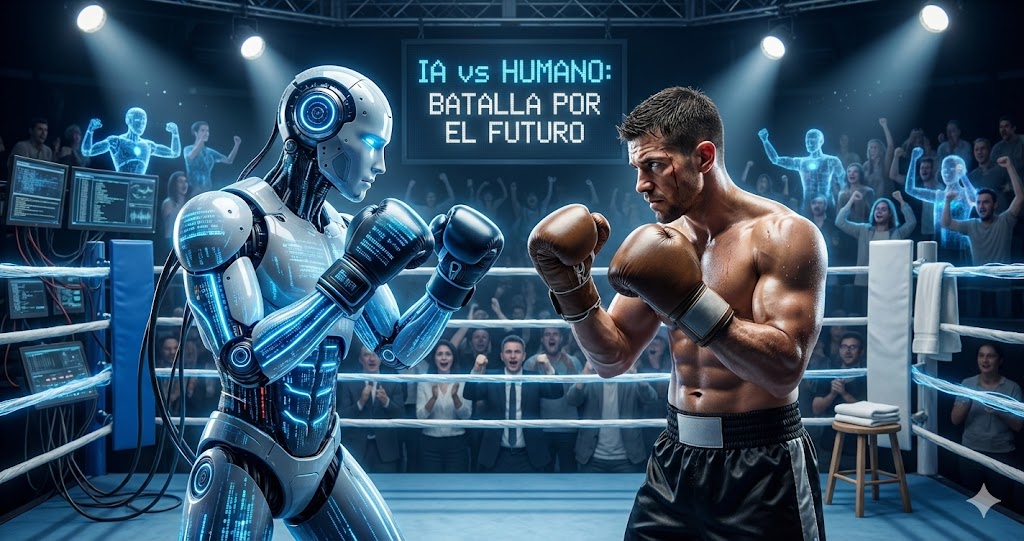
The choice between automatic transcription and manual transcription is increasingly common. On one hand, we want maximum accuracy. On the other, we need fast and affordable results. How do you decide which method to use?
The good news is that advances in artificial intelligence have completely changed the game. Today's AI transcription services achieve accuracy levels that seemed impossible just a few years ago. In this guide, we objectively analyze both options so you can choose the best one for your needs.
What is Automatic Transcription
Automatic transcription uses artificial intelligence and speech recognition models to convert audio to text without human intervention. Systems like OpenAI's Whisper process the audio, identify speech patterns, and generate text with high accuracy.
The technology has evolved dramatically in recent years. Current models understand context, handle different accents, and can process audio with moderate background noise. Platforms like VOCAP use these advanced models to offer fast and accurate transcriptions.
What is Manual Transcription
Manual transcription is the traditional process where a professional listens to the audio and types the text word by word. The transcriber uses headphones, specialized software, and often foot pedals to control audio playback.
An experienced transcriber can type at dictation speed, but still needs to listen to the audio multiple times to ensure accuracy. This method remains relevant when maximum precision is required or when the audio presents specific challenges that AI cannot resolve.
Detailed Comparison
Let's look at a comprehensive comparison of the three available methods:
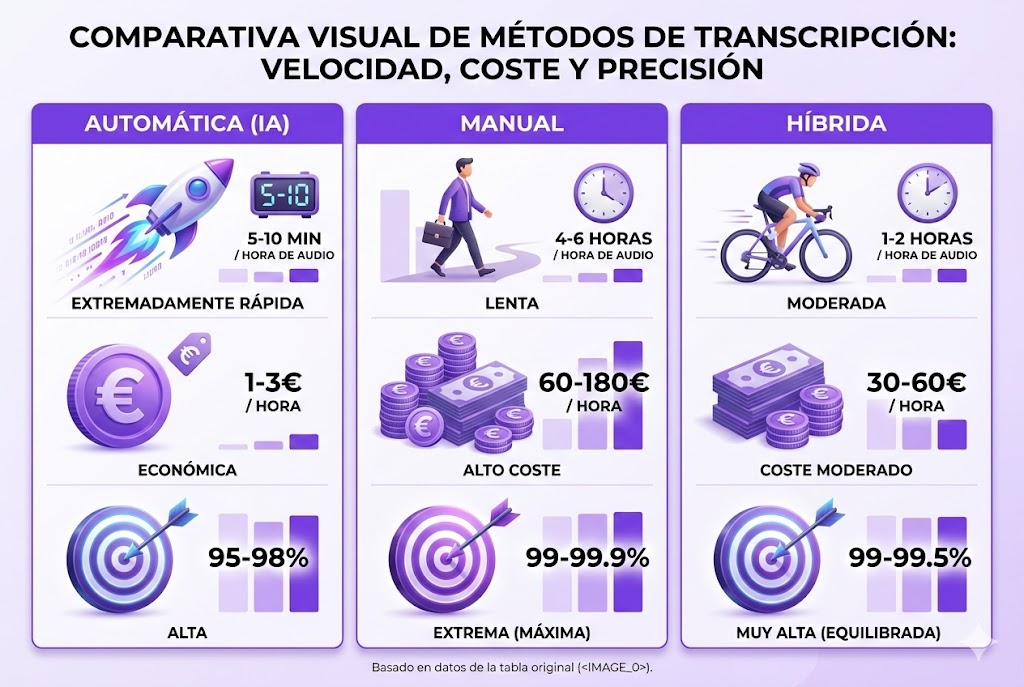
| Criteria | Automatic (AI) | Manual | Hybrid |
|---|---|---|---|
| Speed | 2-3 min/hour of audio | 4-6 hours/hour of audio | 1-2 hours/hour of audio |
| Cost | $1-3/hour | $60-180/hour | $30-60/hour |
| Accuracy | 95-98% | 99-99.9% | 99-99.5% |
| Scalability | Unlimited | Limited | Medium |
| Languages | 50+ at no extra cost | Requires specialist | Depends on reviewer |
| Availability | 24/7 | Business hours | Business hours |
| Best for | Meetings, podcasts, lectures | Legal, medical, regulatory | Professional content, subtitles |
Advantages of Automatic Transcription
- Speed: One hour of audio is processed in 2-3 minutes. Virtually instant results.
- Price: 10 to 20 times cheaper than manual transcription.
- Unlimited scalability: You can process hundreds of hours simultaneously without waiting.
- 24/7 availability: No dependency on schedules or human availability.
- Multiple languages: Supports dozens of languages at no additional cost.
- Consistency: Quality is uniform, without variations due to human fatigue.
Disadvantages of Automatic Transcription
- Sensitive to audio quality: Excessive noise or low-quality recordings reduce accuracy.
- Strong accents: May struggle with very pronounced regional accents.
- Technical terminology: Medical, legal, or highly specialized vocabulary may generate errors.
- Multiple simultaneous speakers: When several people talk at once, accuracy drops.
- No deep contextual understanding: Doesn't interpret irony, sarcasm, or complex nuances.
Advantages of Manual Transcription
- Maximum accuracy: Achieves 99-99.9% precision even with complex audio.
- Context understanding: The transcriber understands meaning and can resolve ambiguities.
- Speaker identification: Perfectly distinguishes who says what.
- Complex audio: Handles low-quality recordings, strong accents, or overlapping speech well.
- Custom formatting: Can apply specific styles according to client requirements.
Disadvantages of Manual Transcription
- High cost: Between $1-3 per minute of audio ($60-180/hour).
- Time: One hour of audio requires 4-6 hours of work.
- Not scalable: Processing large volumes requires many transcribers.
- Planning required: You need to book in advance and wait your turn.
- Variability: Quality can vary depending on the transcriber and their condition.
When to Use Automatic Transcription
AI transcription is the best choice for:
- Work meetings: Documenting decisions and agreements from Zoom, Google Meet, or Teams calls quickly.
- Podcasts and digital content: Creating transcriptions for SEO and accessibility.
- Lectures and webinars: Generating study materials for students.
- High volume of audio: When you have dozens or hundreds of hours to process.
- Limited budget: Maximizing results with tight resources.
- Urgency: You need the text in minutes, not days.
When to Use Manual Transcription
Choose human transcription when:
- Legal documents: Depositions, court proceedings, contracts where every word matters.
- Medical reports: Clinical records with specialized terminology.
- Professional subtitles: Film, television, documentaries with strict standards.
- Very low-quality audio: Old recordings or those with heavy noise.
- Regulatory requirements: Sectors where human review is legally required.
The Hybrid Option: AI + Human Review
The hybrid approach combines the best of both worlds. The process is simple:
- AI transcribes: The system generates an automatic transcription in minutes.
- Human reviews: A professional corrects errors and adjusts formatting.
- Final result: Accuracy close to 99.5% in a fraction of the time.
Key fact: The hybrid method is 80% faster than pure manual transcription, with an intermediate cost and nearly equivalent accuracy.
Real Cost Analysis
Let's look at a practical example with 10 hours of audio (equivalent to about 20 thirty-minute meetings):
| Method | Total Cost | Delivery Time |
|---|---|---|
| Manual | $1,200 - $1,800 | 4-6 weeks |
| Hybrid | $300 - $600 | 1 week |
| Automatic | $10 - $30 | 1 hour |
The difference is significant: for the price of manually transcribing 1 hour, you can transcribe more than 100 hours with AI. View VOCAP pricing.
Accuracy in Numbers
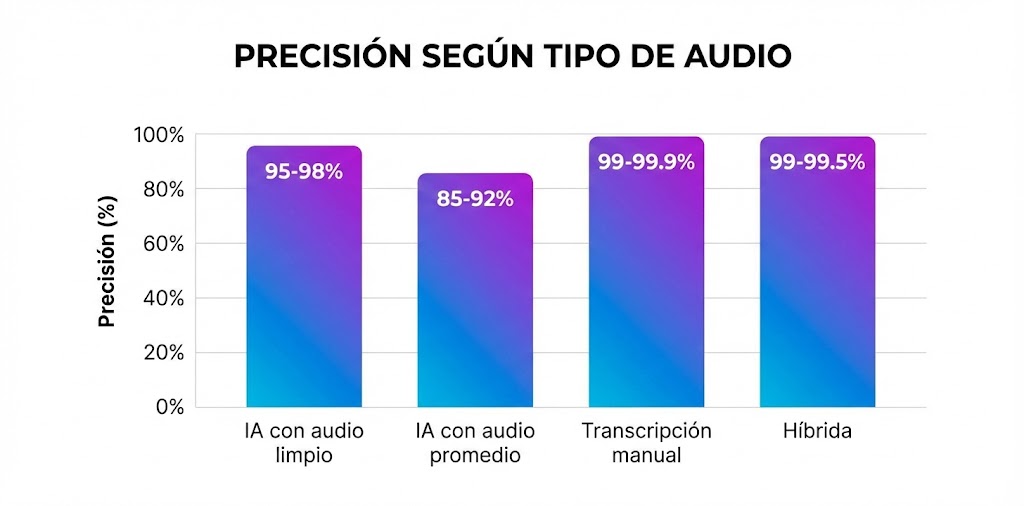
Accuracy varies according to audio conditions:
- AI with clean audio: 95-98% accuracy
- AI with average audio: 85-92% accuracy
- Manual transcription: 99-99.9% accuracy
- Hybrid: 99-99.5% accuracy
Common AI errors: uncommon proper names, industry-specific acronyms, mixed-language words, and quickly dictated numbers.
The Future of Transcription
Automatic transcription technology continues to improve rapidly:
- Advanced multilingual models: Better handling of language switching within the same audio.
- Automatic speaker identification: AI will distinguish who says each sentence.
- Contextual understanding: Models that understand the topic and reduce technical errors.
- Real-time integration: Instant transcription during meetings and calls.
The clear trend is that the hybrid model will become the standard for professional content, while pure AI will dominate everyday use.
Conclusion
There's no single answer. The best option depends on your specific use case, your budget, and your delivery deadlines.
For 80% of users, modern automatic transcription offers the best balance between quality, speed, and price. 95-98% accuracy is more than sufficient for meetings, interviews, podcasts, and most professional content.
Reserve manual transcription for cases where absolute accuracy is critical: legal documents, medical reports, or regulated content.
If your recording has poor quality (background noise, distant voices), check our guide to transcribe poor-quality audio with AI. And if the audio contains personal data, learn how to anonymize transcripts under GDPR.
Frequently Asked Questions
Which is more accurate, automatic or manual transcription?
Manual transcription achieves 99-99.9% accuracy, while automatic AI transcription reaches 95-98% with good quality audio. However, for most professional uses, the difference is minimal.
How much does it cost to transcribe one hour of audio?
Manual transcription costs between €60 and €180 per hour of audio. Automatic AI transcription costs between €1 and €2: with VOCAP's one-time credit packs, from €1.99 for a single hour down to €1/hour with the 30-hour pack (€29.99), no subscription. The hybrid option (AI + human review) costs between €30 and €60.
When should I use manual transcription instead of automatic?
Use manual transcription for legal documents, medical reports, professional subtitles for film/TV, very low quality audio, or when there are strict regulatory requirements.
How long does automatic transcription take?
Approximately 2-3 minutes per hour of audio. A 30-minute meeting is transcribed in 1-2 minutes, and a 2-hour conference in about 5-6 minutes, including AI analysis with summary and key points. Manually transcribing the same audio would take 4 to 6 hours of work.
Can I transcribe several audio files at once?
Yes. VOCAP has no public API or automatic integrations, but you can upload several audio files one after another from your browser. Each transcription is processed independently and stays available in your history — something impossible to scale with manual transcription.
Try Automatic Transcription
15 minutes free to test the quality. No credit card required. Results in minutes.
Try VOCAP Free